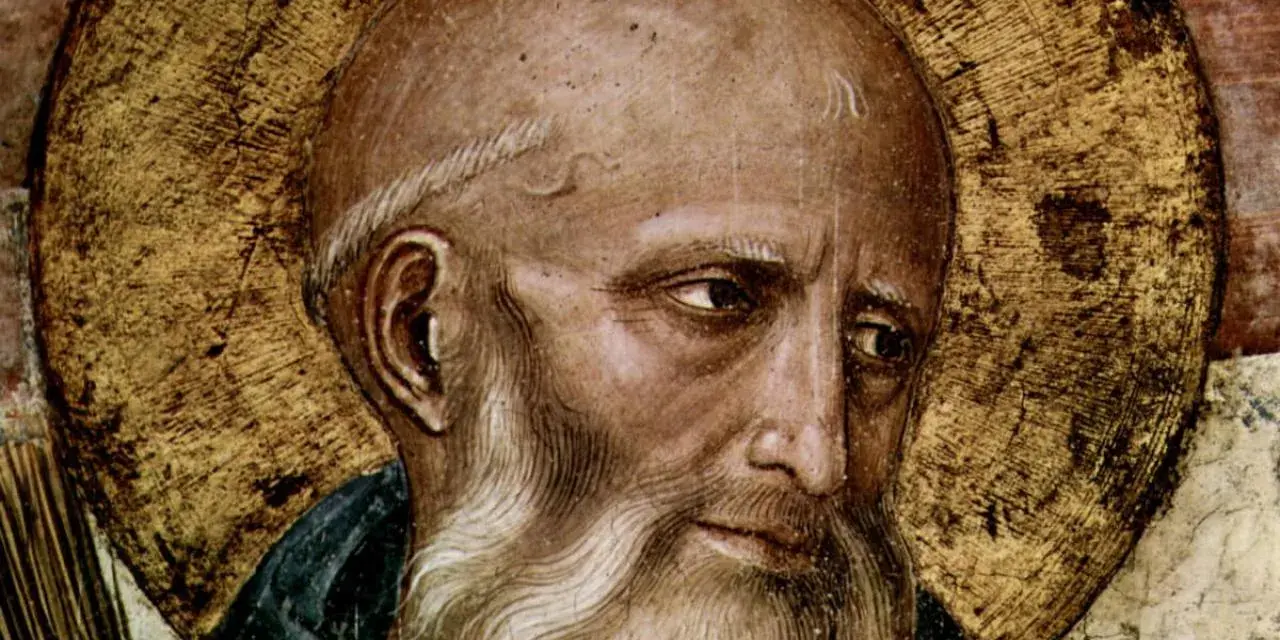
St. Benedict the Abbot remains one of the most important figures in Western monastic history because his life joined spiritual discipline with practical leadership. His story runs from a solitary retreat at Subiaco to the foundation of Monte Cassino, and from there to the Rule that shaped centuries of Christian life in Europe. For readers interested in saints, religious heritage, or the roots of monastery culture, he is a case where biography, liturgy, and history all meet in one person.
The essentials behind Benedict’s lasting influence
- Benedict of Nursia was a 6th-century monk and abbot whose life is linked with Subiaco and Monte Cassino.
- His Rule has 73 short chapters and became a practical guide for communal religious life.
- The Rule endured because it balanced prayer, work, obedience, humility, and hospitality instead of pushing extremes.
- He is honored in the Catholic tradition on July 11 and is widely recognized as patron of Europe.
- His most common symbols in art are the book, abbot’s staff, raven, and broken cup.
Who Benedict of Nursia was and why the title matters
Benedict was born around 480 in Nursia, in central Italy, at a time when the Roman world in the West was changing fast. He studied in Rome, but the life he found there did not satisfy him, and he eventually withdrew from the city to seek a more disciplined Christian life. Tradition places him first at Subiaco, where he lived as a hermit before gathering disciples and founding monastic communities.
The title abbot matters here. It does not simply mean “holy man”; it means the head of a monastery, the person responsible for order, formation, and daily life. I find that detail important because it shows Benedict’s authority was practical as much as spiritual. He was not remembered only for withdrawal from the world, but for creating a form of life that others could actually follow.
That practical side becomes much clearer once you look at the Rule he gave to his communities, because the Rule is where Benedict’s influence truly begins.
The Rule that turned an ideal into a daily rhythm
The Rule of Saint Benedict is the text that made his name endure. It is not long by medieval standards, but it is remarkably concrete: 73 chapters that deal with prayer, work, obedience, leadership, food, sleep, discipline, and the social life of a monastery. I read it less as an abstract spiritual essay and more as a manual for sustainable communal life.
| Principle | What it means in practice | Why it mattered |
|---|---|---|
| Stability | Monks commit to one community instead of moving constantly. | It creates continuity and responsibility. |
| Obedience | Personal preference is placed under shared discipline. | It reduces conflict and keeps the community aligned. |
| Prayer and work | Worship is joined to manual labor and sacred reading. | It keeps spirituality grounded in daily action. |
| Moderation | Ascetic life is serious, but not destructive or theatrical. | It made the Rule adaptable for many kinds of communities. |
| Hospitality | Guests are received with care and reverence. | Monasteries became spiritual and social centers. |
The striking thing is not that the Rule is severe, but that it is balanced. In a period when some forms of holiness leaned toward extreme withdrawal, Benedict offered a pattern that was demanding without being chaotic. That balance is a major reason the text outlived its first century and became a standard for Western monasticism.
Once that standard took root, the next question was how it spread so widely across Europe.
Why his model spread across Europe
Benedict’s influence expanded because his Rule could travel. It did not depend on one personality or one local custom; it could be copied, taught, and adapted across regions. For the religious history of Europe, that matters a great deal. Monasteries built on Benedictine principles became places where prayer, literacy, agriculture, hospitality, and administrative order could survive together even when civil structures were unstable.
I would describe this as one of Benedict’s quiet achievements: he gave Europe a shared monastic grammar. Communities following his Rule had a common way of organizing time, authority, and labor, which made them easier to sustain over generations. That is not a glamorous kind of influence, but it is the kind that lasts.
- Liturgical rhythm kept prayer anchored to the day instead of left to private feeling.
- Shared labor kept monastic life economically workable.
- Copying and reading helped monasteries become centers of learning.
- Hospitality gave monasteries a public role, not just a private one.
- Local adaptability allowed the Rule to survive in very different European settings.
This is also why Benedict is so important to the story of European heritage. His monasteries were not only places of devotion; they were durable cultural institutions. The next layer of meaning appears in the way he is remembered in art and liturgy.
How to recognize him in art and liturgy
In the Catholic calendar, Benedict is commemorated on July 11. He is widely honored as patron of Europe, and in devotional tradition he is also linked to monks, students, and the broader life of disciplined Christian formation. The feast day and the title are useful reminders that his memory is not just historical; it is liturgical and living.
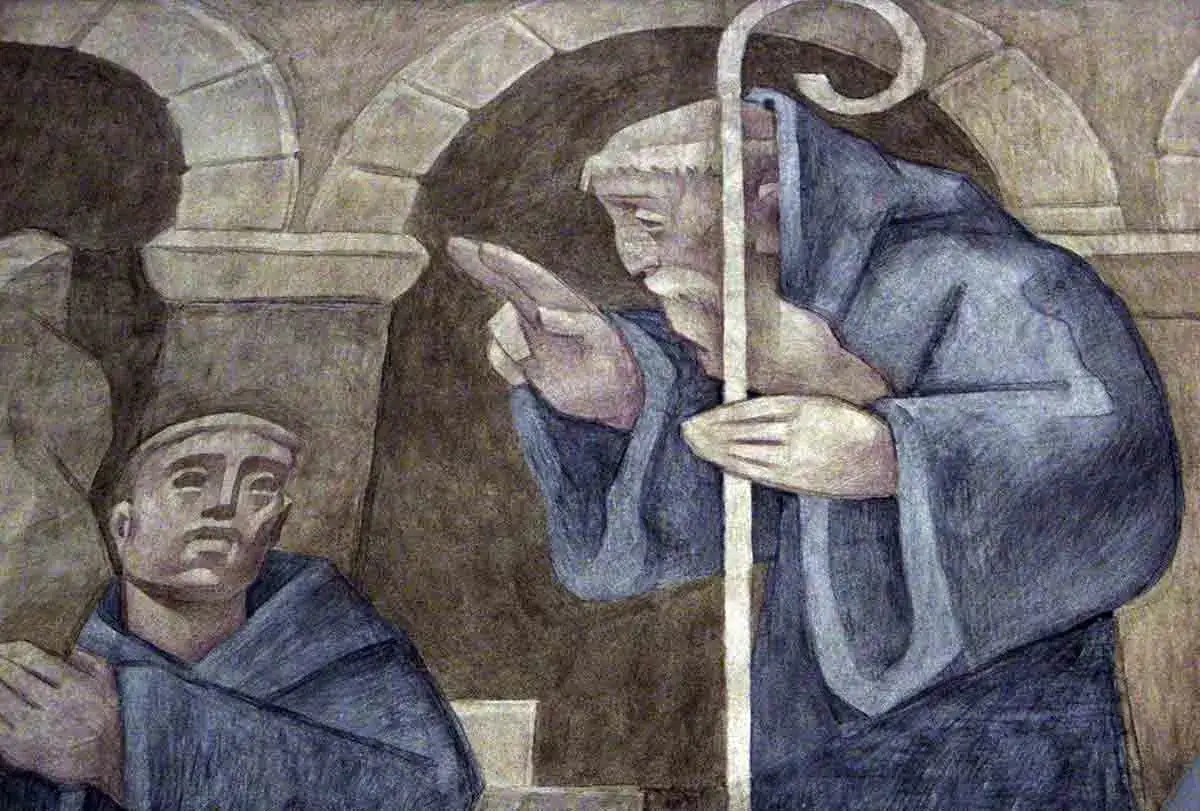
He is also one of the easier saints to identify once you know the symbols. I like to explain his iconography as a story in objects, because each sign points to a specific episode or role.
- Book points to the Rule and to monastic teaching.
- Abbot’s staff marks his role as a leader of a community.
- Raven recalls the tradition that a bird carried away poisoned bread.
- Broken cup recalls another poison attempt that failed.
Those images are not decorative extras. They are visual shorthand for the kind of holiness Benedict represented: disciplined, tested, and deeply communal. They also prepare the ground for the real question modern readers usually ask, which is why this saint still feels relevant now.
What Benedict still teaches about a workable rule of life
In 2026, Benedict still speaks to people because he does not romanticize spiritual life. He offers structure. That may sound modest, but it is exactly what makes him durable: he understood that a healthy life needs rhythm, limits, shared responsibility, and time set apart for reflection. I think that is why his legacy continues to matter even far beyond monasteries.
The modern reader does not need to copy sixth-century monasticism to learn from him. The deeper lesson is that a rule of life works best when it is consistent, humane, and realistic. Benedict does not ask for spectacle; he asks for order. He does not promise instant perfection; he builds habits that make perseverance possible. That is a useful saint to remember when burnout, distraction, and improvisation start to look like normal life.
- Keep a daily rhythm instead of relying on occasional intensity.
- Choose moderation over heroic gestures that cannot be sustained.
- Treat work as part of formation, not as a spiritual distraction.
- Value community because discipline is easier to maintain with accountability.
For readers approaching Benedict from the angle of saints and European religious history, that may be the most practical way to read him: not as a distant emblem, but as a teacher of durable habits. His legacy still works because it is built for real people, real limits, and real communities.